
Al-Manatir was the third of a series of protest camps established by various Palestinian activists across the occupied West Bank. This camp was set up in Burin, a village in the southwest of Nablus that has been suffering settler violence and land grabs for decades.
On 2nd February 2013 hundreds of residents from Burin along with Palestinian and international activists established al-Manatir neighbourhood on the top of a hill threatened by confiscation by Israeli settlers from the Bracha and Yitzhar settlements. Despite the hilltop being considered as Area B, according to the Oslo Accords, the Israeli army has prevented residents of Burin from accessing it since 2007.
The new Burin neighbourhood, al-Manatir, was named after the traditional stone huts Palestinians built in their agricultural lands and used as shelters for the watchmen of the fields. With this protest camp, Burin’s residents and Palestinian activists wanted to protest against the expansion of the nearby settlements and resist the constant settler attacks and army harassment in the village.
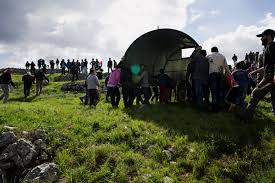
Palestinian activists carrying a metal hut up the hill (Photo by Simon Krieger)
However, while the new residents of al-Manatir were setting up their makeshift huts and tents, they were attacked by settlers accompanied by Israeli soldiers and border police, who violently evicted the neighbourhood and arrested eight people, three of them remaining in Israeli prison for 12 days.
The violent dismantlement of al-Manatir protest camp
Early on Saturday morning, as hundreds of people were carrying materials such as tents and metal huts up the hill, a group of Israeli soldiers, border police and masked settlers from the nearby settlements of Bracha and Yitzhar, arrived in the area.
Without provocation, the settlers began hurling stones while Israeli soldiers and border police were throwing stun grenades and tear gas canisters at some of the Palestinians carrying metal huts up the hill. While the settlers were stealing some of the building equipment, Israeli forces protected them by firing more tear gas canisters at Palestinians.
Scuffles broke out and Israeli forces violently arrested several Palestinian activists, pepper-spraying their faces and beating them, despite being already immobolised. Waheeb Qadoos was filmed being repeatedly kicked by soldiers while lying on the ground, not posing any resistance to his arrest.
Settler reprisal
Shortly after the situation in al-Manatir began to get violent, masked settlers from the Yitzhar settlement, situated across the road 60, southwest of Burin, armed with slingshots and guns, chopped down a hundred olive trees and indiscriminately attacked several Palestinian houses situated in the outskirts of Burin. Some Palestinian youth ran to the area and further clashes ensued. A settler shot a 17 year-old Palestinian boy, Zakaria Najjar, in the right leg with live ammunition.
Soon afterwards, the Israeli army and border police arrived at the scene and continued to side with settlers by shooting tear gas canisters at Palestinian families who had taken refuge inside their homes. A 28 day-old baby was hospitalised as a result of exposure to tear gas.
Back on the hilltop, the Israeli army and border police continued to shoot tear gas canisters and stun grenades at the Palestinians who were trying to keep al-Manatir alive. Dozens of people were injured, most of them from being hit by tear gas canisters and stun grenades. As the Israeli army illegally pushed residents of al-Manatir down to the edge of the hill, soldiers, border police and settlers took it over.
Soon after protesters were pushed down to the centre of Burin, Israeli forces raided the village and continued to shoot large quantities of tear gas canisters, stun grenades and rubber-coated steel bullets at Palestinian residents and activists. The violent raid lasted until nightfall, when the Israeli army and border police pulled back from the village. However, they continued to occupy the hill. The eviction of al-Manatir neighbourhood was illegal even under Israeli military laws.
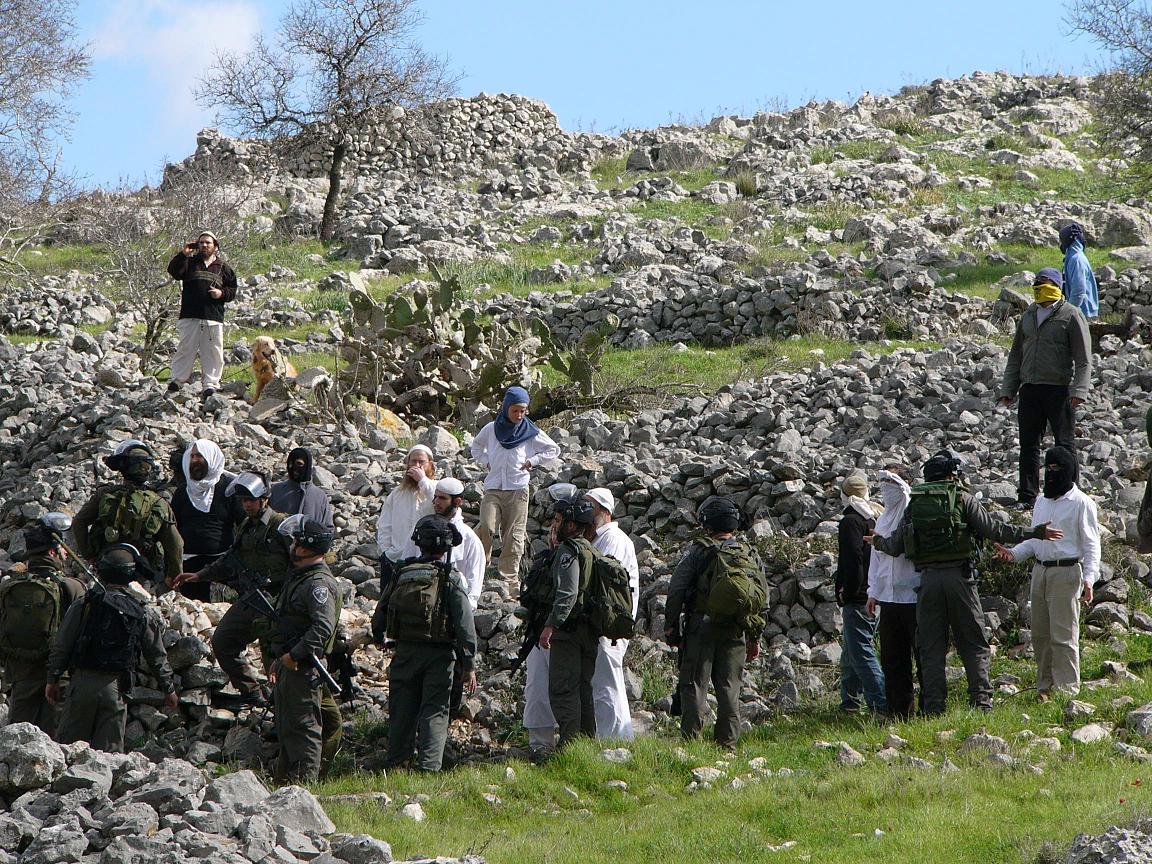
Settlers and Israeli forces at al-Manatir (Photo by Katie W.)
The hilltop where al-Manatir was established is considered, according to the Oslo Accords, as Area B, an area over which the Palestinian Authority holds administrative authority. The Israeli military evacuated the area without producing an eviction order as required by their own laws.
Military repression and reprisal
From the eight Palestinian activists that were violently arrested during al-Manatir protest camp, three of them -one a minor-, remained in Megiddo prison for twelve days. All three were accused of participating in a march without permission and of stones-throwing. The two adults, Waheeb Qadoos and Ashraf Abu Rahma, were potentially facing charges of assaulting soldiers.
On Wednesday 6th February, as they arrived in court, the military prosecution presented secret evidence to the military judge explaining why they needed five days in order to complete the investigation. According to the military judge, this would include looking into violence from the Israeli settlers. The military prosecution stated that an Israeli soldierc had testified against and identified each of the detainees. The Military Judge ruled that since the three suspects were “dangerous to the security of the area” they could not be released on bail or to house arrest and it was necessary to keep them in prison while the investigation was being completed.
On Sunday 10th, the trial was again postponed until Tuesday 12th. Once again the military insisted that the detainees were dangerous and therefore could not be released.
Defense attorney Adel Samara submitted photos and video material to the military prosecution showing that the detainees where non-violent during their arrest and were themselves severely beaten and pepper sprayed by the soldiers and border police. The photo and video material also showed how Israeli settlers threw stones and stole equipment, but were not arrested or even questioned by the authorities. Since none of these events where mentioned in the testimonies of the soldiers, Qadoos, Abu Rahma and Baniouda were finally released without charges on Thursday 14th of February 2013.
As well as the imprisonment of the three al-Manatir residents, further reprisals took place in Burin in the following days. The same Saturday, as the army kept a constant presence on the hilltop, a checkpoint was set up at the main entrance of the village, sealing it off.
The following day, at around 8pm, several Israeli army jeeps and an ambulance disguised as Palestinian and driven by a plain-clothed Israeli soldier drove into the village. Eight soldiers, all in black and wearing balaclavas, jumped out and entered a house, where they arrested Ghassan (23) and Mohammed (19) Najjar. Handcuffed and blindfolded, Ghassan was taken to an army jeep and, there, he was interrogated about the earlier al-Manatir action by a military commander before being released. In the case of Mohammed, he was brought, also handcuffed and blindfolded, to Huwwara military base before being released.
But the reprisal did not finish here. Five days later, the Israeli army raid Ghassan Najjar’s house and took his computer, only to give it back half an hour later. No explanation was given. As usual in Burin, soldiers invaded the village to do military training almost every night during that week, disturbing the residents’ sleep.
On the 24th of February, Israeli forces raided the village at night and arrested Mahmoud Nasser Asaus (17) and Magdi Loai Najjar (24). Both of them were taken to Kishon Interrogation Centre in Haifa. More arrests are expected to happen in the upcoming weeks.
Meanwhile, the hilltop continues to be sealed off by Israeli soldiers and border police, currently denying Burin’s residents access to their own land upon which their livelihoods depend.
Burin: a catalogue of injustice
Burin is a village located 7 kilometres southwest of the city of Nablus. The village’s 2,500 residents reside on approximately 1300 dunums (a dunum is equivalent to a thousand square metres). Since the 1967 Israeli occupation, Burin’s land and water resources have gradually been reduced due to expropriation by Israeli settlements and military bases. Since 1982 more than 2,000 dunums of the village’s land have been declared “state land” by the Israeli Civil Administration, a formality before handing it over to the settlers of Bracha and Yitzhar.
The village, situated in between two of the most violent and fundamentalist settlements in the occupied West Bank, Yizhar, (which originated the ´price-tag´ tactic of attack) and Bracha, has been facing constant harassment, intimidation and violence by both the settlers and the Israeli army. Settlers systematically cut down and burn olive trees, destroy property and attack residents from Burin. Since 2003, many villagers have lost access to their fields and olive trees situated on the other side of road 60.
Israeli settlements and land confiscations in the occupied Palestinian territory has recently been reviewed in a report submitted to the UN´s Human Rights Council by an independent fact-finding mission specially formed to investigate the issue. The report harshly criticises the Israeli authorities for deliberately choosing to ignore rather than punishing settlers’ acts of violence, which it describes as “institutionalized discrimination against the Palestinian people” with the aim of driving them out from their land and expanding settlements. The report also called on all relevant international actors, private or state-connected to take “all necessary steps” to ensure that they were respecting human rights, “including by terminating their business interests in the settlements” .
In a recent report, European Union´s consuls general in Ramallah and Jerusalem also recommended divestment from and economic sanctions against settlements in the West Bank and East Jerusalem.


