
On the 2nd of march 2014, the Israeli forces delivered a new demolition order to the Bedouin community living in Ras Al Azayreh (Jabal AlBaba) next to Ezariyeh town in the so-called area E1. The demolition order is the fourth against the same community, in addition to other 18 “stop building” orders given to families last week.
Moreover, on February the 26th at night Israeli settlers from Ma’ale Amos settlement attacked the Palestinian village of Kisan east in Bethlehem and demolished a house belonging to a Palestinian family of 10 members. The settlers demolished the house using hammers and partially destroyed another building belonging to the same family.
One of the family members, Yacoub Ghouzlan, reported that Israeli settlers arrived at the village at 9:00 PM and demolished completely one of the family houses and, partially, the second one. Both Ghouzlan’s family houses were still under construction and 50 meters square in terms of size.
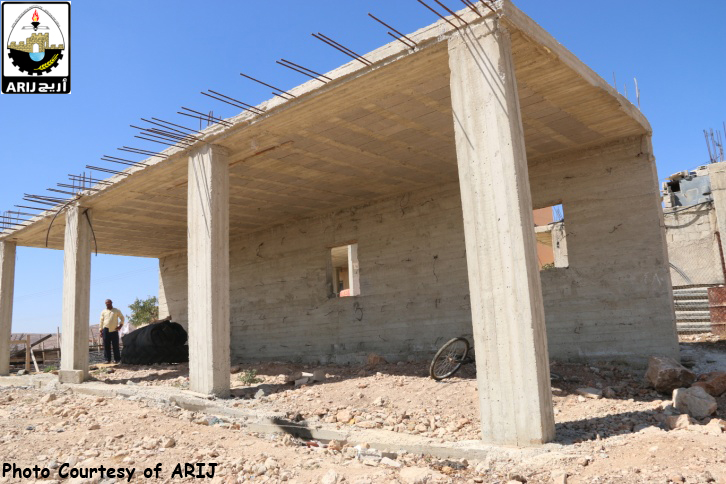
House in construction by local residents in Kisan Village, southeast Bethlehem
The United Nations Office for the Coordination of Humanitarian Affairs (OCHA) has being warning about the vulnerability of thousands of Palestinians throughout the Occupied Palestinian Territories (OPT) that have been or might be forcibly displaced due to the Israeli military occupation. “Many Palestinians have suffered multiple displacements, having lost their homes and livelihoods more than once. Forced displacement has a series of immediate and longer-term physical, socio-economic and psychosocial impacts on Palestinian families. It deprives them of their home and land – often their main asset – and frequently results in disruption to livelihoods, a reduced standard of living and limited access to basic services. The impact on children can be particularly devastating.”
The most vulnerable areas, due to the reparation of military control and sovereignty by the Oslo agreements, are East Jerusalem and the C Area in West Bank. In these areas, hundreds of Palestinian structures are demolished every year “due to the lack of Israeli-issued building permits. The restrictive planning system makes it almost impossible for Palestinians to obtain permits, while providing preferential treatment for Israeli settlements.” In fact, several families have seen their homes demolished once and once again and most of the Palestinians living in those areas are forced to build without permits to fulfill their needs.
The Israeli NGO Bimkom – Planners for Planning Rights -, asserts that “it is estimated that amongst the 39,000 existing housing units in East Jerusalem, about 20,000 have been built without permits. More than 10,000 additional housing units are required to meet the needs of Palestinian residents and the shortage continues to grow by about 1,500 every year. Further, there is a tremendous shortage of schools/classrooms, health clinics, public gardens, playgrounds and sports facilities.”
With the figures of 2013, OCHA signaled the following trends:
- There has been a significant rise in demolitions and displacement in East Jerusalem in 2013; more people have been displaced so far in 2013 than in 2011 (88) and 2012 (73) combined.
- While the monthly average of structures demolished in Area C has increased slightly – up 8 per cent from 2012-, the average number of displaced persons is relatively the same, 68 compared to 67.
- The number of demolitions has increased by 20% in the Jordan Valley in 2013 compared to 2012, when 172 were demolished: in 2013, the number arrived to 390. The Bedouin and herding communities have been the most affected.
- 12,500 people in the Gaza Strip remain displaced, after last summer’s Israeli military operation destroyed their homes.
The constant house demolition policies of Israeli occupation are increasing in the E1 area (the Bab Al Shams area), especially targeting the Bedouin communities and the Bethlehem’s area, according to the popular committees of Bethlehem and Ezariyeh. The specific case of demolition in Kisan is considered a new form of violation where settlers are the ones to demolish instead of Israeli forces.
A reaction from the international community and the solidarity worldwide groups is urgent to pressure their governments to take actions against Israeli policies, which are attempting to ethnically cleanse the Palestinian existence from Palestinian lands. It is also needed, as a form of pressure on Israel, to continue the boycott against Israeli businesses and companies exporting to Europe and North America.


