
On June 8, 2015, prominent nonviolent resistance leader Iyad Burnat of Palestine received the James Lawson Award for Achievement in the Practice of Nonviolent Conflict.
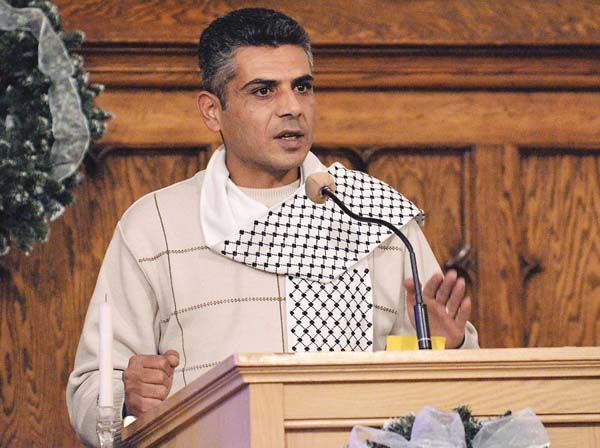
Iyad Burnat is a recognized leader in the movement of nonviolent resistance, not only in Palestine but all over the world. For Iyad Burnat, nonviolent resistance is fundamental, it is his daily life and is especially something he teaches to his children and all the children of his village since childhood.
Images and footage of Bil’in’s resistance have spread across the world, in large part due to the movement’s characteristic use of creative actions, which have increasingly captured the attention of international journalists.
Iyad started very young to participate in the nonviolent movement in Palestine, and equally young has suffered injustice and repression from the Israeli military. At the age of 17, Iyad was arrested and later forced to sign a false confession by the Israeli military. He was then sentenced as a minor to two years in a desert prison.Yet throughout his years of nonviolent resistance, Iyad’s message has not waivered: “We are not against Jews; we are against the Israeli occupation”.
Bil’in was among the first villages to organize nonviolent resistance against the wall. Facing sustained repression — including beatings, arrests, torture, home night raids, kidnapping of children and killing of unarmed participants — from Israeli soldiers and settlers, the Palestinians from Bil’in and their partners have continued their resistance nonviolently, including weekly marches every Friday now for more than a decade.
The Palestine experience in nonviolent struggle beginning in the 1930s and continuing through the first and nonviolent aspects of the second intifada. Burnat explains that the impetus for Palestinians to resist is embedded in their daily reality — their lives and environment under occupation teach them to resist. “I learned a lot of methods from Gandhi, Martin Luther King and Nelson Mandela, but life teaches more. When you struggle and live the life under occupation; when you are suffering and in pain every day, it teaches you how to resist. It comes from the life. Nonviolent struggle comes from the life. We are a simple people and nonviolent resistance is a part of our lives.” Bil’in has become known for its weekly marches and for originating creative ideas and diverse tactics of nonviolent resistance. Examples include protesters tying themselves to olive trees that are being uprooted by bulldozers to make way for the wall; locking themselves in cages which then must be hauled away by cranes; or chaining themselves to steel pillars on the ground. The farmers of Bil’in also seek to win over the soldiers, offering flowers or joking with them to find the human connection, even as the soldiers continue to arrest, beat and sometimes kill them.
The interim goals of the nonviolent resistance were to drive up the material costs of the wall, reduce the legitimacy of it and its supporters, and delay its construction so that complementary legal challenges and media strategies would have more time to work. These goals were achieved, as the financial costs increased exponentially and the farmer of Bil’in have also managed to ensure that the wall was rerouted, regaining 500 dunums (4 = 1 acre) of land. The wish of Iyad Burnat is to start the third intifada to bring together all Palestinians. His idea is to build a global movement to end the occupation.


