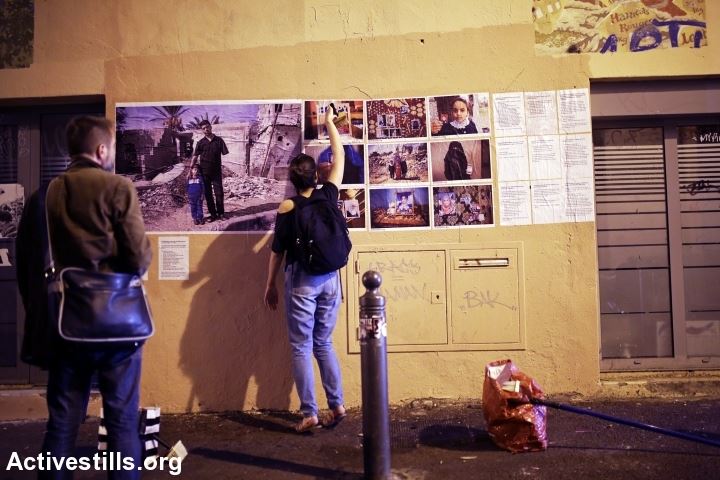
2014. After the discovery, on June 30th, of the bodies of three Jewish students and the killing of a Palestinian child, the escalation of hostilities break out in Gaza. On July 7th, Israel launched the Operation ‘Protective Edge’ with hundreds of air strikes across the Gaza Strip. Thousands of homes were affected. No notice were done for evacuate civilians or finding safe shelters. Among other attacks, it should be notice that in the night between the 29th and the 30th of July, the primary school run by the UNRWA (the UN agency for Palestinian refugees), was attacked in Jabaliya, leaving at least 20 dead and dozens injured.
51 days of military attack on civilians
The conflict lasted 51 days. 2,139 Palestinians dead. The United Nations estimates that 71% of deaths were civilians, nearly half of them women and children. In addition, 800,000 people were affected between displaced persons and refugees; and more than 20,000 homes were destroyed.
During the conflict, the Israeli army has deployed or used a wide range of conventional weapons, including missiles, large caliber artillery systems, military aircraft for surveillance and weapons, fighter jets, tanks, armored vehicles, ships and small arms and light weapons (SALW) with ammunition. Palestinian armed groups have used or deployed launchers, rockets and small arms with corresponding ammunition. Those was the worst conflict in the Gaza Strip since Operation Pillar of Defense 2012.
Supporting justice in Gaza
A year later there has been no justice for the people of Gaza despite that last June the independent commission of inquiry appointed by the Council of Human Rights of the United Nations published a report accusing Israel and armed Palestinian factions, including Hamas, of violating international law and possible war crimes during the conflict in 2014.“The extent of the devastation and human suffering in Gaza was unprecedented and will impact generations to come “, said the President of the Commission of Inquiry Mary McGowan Davis.
The same conclusion was reached in the emergency session of the Russell Tribunal on Palestine, held the 24th and 25th of September 2014 in Brussels. Going further it was make reference to the general situation in Gaza in recent decades: ‘The cumulative effect of the long-standing regime of collective punishment in Gaza appears to inflict conditions of life calculated to bring about the incremental destruction of the Palestinians as a group in Gaza’.
If, on the institutional side, they are trying little by little to move towards a resolution; the social side has been more active and some groups have begun a campaign so that Gaza will not be forgotten, and the international community commit itself in reconstruction and aid. Among all groups and organizations, NOVACT also supports the fight for freedom and the rights of the Palestinians with a project in collaboration with the group PCHR – Palestinian Centre for Human Rights.
Activestills, has proposed a photographic campaign, making available on its Facebook page an exhibition kit including digital images ready to be printed. To commemorate the year of the slaughter, they proposed an action photographic campaign, making available on his Facebook page an ‘exhibition kit’ including digital images ready to be printed. They call on all groups, activists and people to spread and expose these photos and share it in the social networks using the hashtag #ObliteratedFamilies. This and other actions have taken place digitally and in the streets of European cities because suffering can be overcome but not forgotten.